
- Art
- 14/01/2022 19:20
- 2539 Views

Christo Vladimirov Javacheff
Buildings, nature, entire cities… Christo’s fabric transformed space into a message of freedom and imagination
Christo (1935–2020) was one of the most original installation artists in the world, born in Bulgaria. He became internationally renowned for his monumental “wrapping art,” in which he covered cities, landscapes, and architectural landmarks with massive sheets of fabric, prompting a fresh reflection on the relationship between humans and space.
Artistic Vision
Christo’s work was radically different from traditional sculpture or painting. By wrapping everyday spaces—such as buildings, islands, bridges, and streets—in materials like fabric and rope, he pioneered a new realm of public art. His artworks were ephemeral, often dismantled within days or weeks of completion. Nevertheless, each project required years of negotiation, planning, and approval before it could be realized.
Major Works
Wrapped Reichstag (Berlin, 1995)
It covered the German parliament building in over 100,000 square meters of silver fabric. This project, decades in the making, aimed to transform a politically and historically charged structure into a space of reflection, rebirth, and public engagement. Inspired by avant-garde movements and a desire for artistic freedom, the artists envisioned wrapping as a way to separate architecture from its past and invite new meaning. Set against the backdrop of German reunification, the Wrapped Reichstag became a symbol of hope, renewal, and national transformation. Despite facing strong political opposition, the project was ultimately approved and received overwhelming public support—over five million visitors attended in just two weeks. The installation allowed Berliners to momentarily escape historical burdens and reimagine their future. It also sparked lasting discussions about public memory, identity, and the power of ephemeral art.
Today, the Wrapped Reichstag remains a landmark in contemporary art history and a powerful example of how art can shape collective healing and national narrative. Christo’s vision continues to influence urban design and cultural restoration projects around the world.
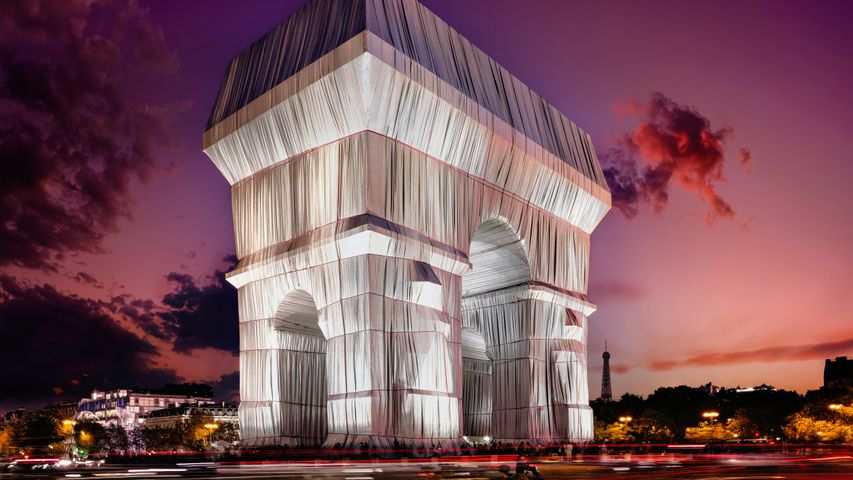
L’Arc de Triomphe, Wrapped (Paris, 2021 – completed posthumously)
It was a monumental public art project by Christo and Jeanne-Claude, realized posthumously in 2021—60 years after it was first conceived. The installation covered Paris’s Arc de Triomphe with 25,000 square meters of recyclable silvery-blue fabric and 7,000 meters of red rope, displayed for 16 days. Originally set for spring 2020, it was delayed due to the pandemic and Christo’s death, but completed by his team with the French government's support. Funded entirely through sales of preparatory sketches, the €14 million project drew millions and celebrated artistic freedom and the legacy of temporary monumental art. First visualized in the 1960s and revived in 2017, the project was praised by Paris Mayor Anne Hidalgo as a tribute to modern art and Christo’s connection to the city.
The Floating Piers (Italy, 2016)
/A floating walkway installation across Lake Iseo that allowed visitors to experience the sensation of w alking on water. / The Floating Piers was a large-scale installation art project first conceived by Christo and Jeanne-Claude in 1970 and realized for just 16 days from June 18 to July 3, 2016, on Lake Iseo in Italy. The project featured a floating walkway made of approximately 100,000 square meters of saffron-colored fabric and 220,000 high-density polyethylene cubes, allowing visitors to experience the sensation of "walking on water."
The total cost reached $17 million, fully funded by Christo himself through the sale of his sketches and preparatory works. The three-month installation involved 600 workers; a Bulgarian company installed anchors at depths of up to 92 meters on the lakebed, and a German firm produced the fabric.
Within the first five days, the project attracted 270,000 visitors, and over its full run, an estimated 1.2 to 1.6 million people came to see it. The Floating Piers blurred the boundaries between nature, people, and art—creating an extraordinary, temporary celebration.
Surrounded Islands (Miami, 1983)
Eleven islands in Biscayne Bay were wrapped in pink fabric, presenting nature in a striking new perspective. The 11 uninhabited islands were encircled with 603,870 m² (6.5 million ft²) of floating pink woven polypropylene fabric that extended 61 meters from each shoreline. The installation stretched over 11.3 km and was visible and accessible from land, sea, and air for two weeks.
The luminous pink fabric harmonized with the tropical vegetation, sky, and shallow waters, creating a striking visual experience. Preparation began in 1981 and involved extensive collaboration with scientists, engineers, and environmental agencies. Over 40 tons of garbage were removed from the islands before installation.
Life and Philosophy
Born in Gabrovo, Bulgaria, in 1935, Christo fled the communist regime in 1957 and eventually moved to the United States. Together with his lifelong artistic partner and wife, Jeanne-Claude, he carried out projects around the world. Christo deeply valued artistic freedom and non-commercialism, financing all of his projects independently without corporate or government funding.
Bulgaria and the World
Though Christo worked primarily in Western Europe and the United States, he always cherished his Bulgarian identity. His art reflects a profound meditation on freedom, nature, ephemerality, and the human condition, transcending boundaries and historical constraints.